

RoyaltyShelf AI Review: Create Bilingual Books and Earn Amazon KDP Royalties?

Hi, this is Saif. Welcome to my RoyaltyShelf AI Review!
Are you looking for a way to create children’s books, bilingual workbooks, coloring books, and puzzles with AI? RoyaltyShelf AI is designed to simplify the process by generating bilingual publishing assets and preparing them for Amazon Kindle Direct Publishing (KDP).
The software focuses on a specific publishing opportunity: educational books for families, teachers, and children who want to learn in two languages.
Rather than writing stories, translating content, designing illustrations, and formatting book interiors by hand, users can handle these tasks in one platform.
Is RoyaltyShelf AI worth buying, and can beginners use it without speaking another language? What does the front-end offer include? More importantly, is it realistic to earn money by publishing AI-generated bilingual books?
This RoyaltyShelf AI review looks at its features, workflow, pricing, business opportunities, limitations, and Amazon KDP requirements. It also covers what to understand before investing in the software.
RoyaltyShelf AI Review: Quick Overview
ClicksBotz presents RoyaltyShelf AI as an AI-powered platform for creating bilingual books.
Its main purpose is to help users create bilingual children’s books and educational resources without handling every writing, illustration, and formatting task themselves.
| Details | Information |
| Product | RoyaltyShelf AI |
| Developer | ClicksBotz |
| Category | AI publishing software |
| Platform | Cloud-based application |
| Main purpose | Bilingual book creation |
| Supported languages | Spanish, French, German, Portuguese paired with English |
| Book formats | Stories, workbooks, coloring books, puzzles and more |
| Publishing platform | Amazon KDP |
| Other formats | Ebook and printable PDF |
| Advertised launch price | $14 one-time |
| Advertised coupon | EARLYSHELF |
| Money-back guarantee | 30 days, according to the sales page |
| Commercial license | Advertised as included |
Check the advertised price and package at checkout, since launch offers, bonuses, and upgrade availability can change.
What Is RoyaltyShelf AI?
RoyaltyShelf AI helps turn publishing ideas into bilingual digital and print-ready book assets.
For example, say you want to create a Spanish-English alphabet workbook for children.
Normally, you might need:
- A children’s book writer.
- A Spanish translator.
- A native-language proofreader.
- An illustrator.
- A book formatter.
- Someone to prepare the Amazon listing.
That process can be expensive and time-consuming.
RoyaltyShelf AI aims to bring many of these tasks together in one workflow.
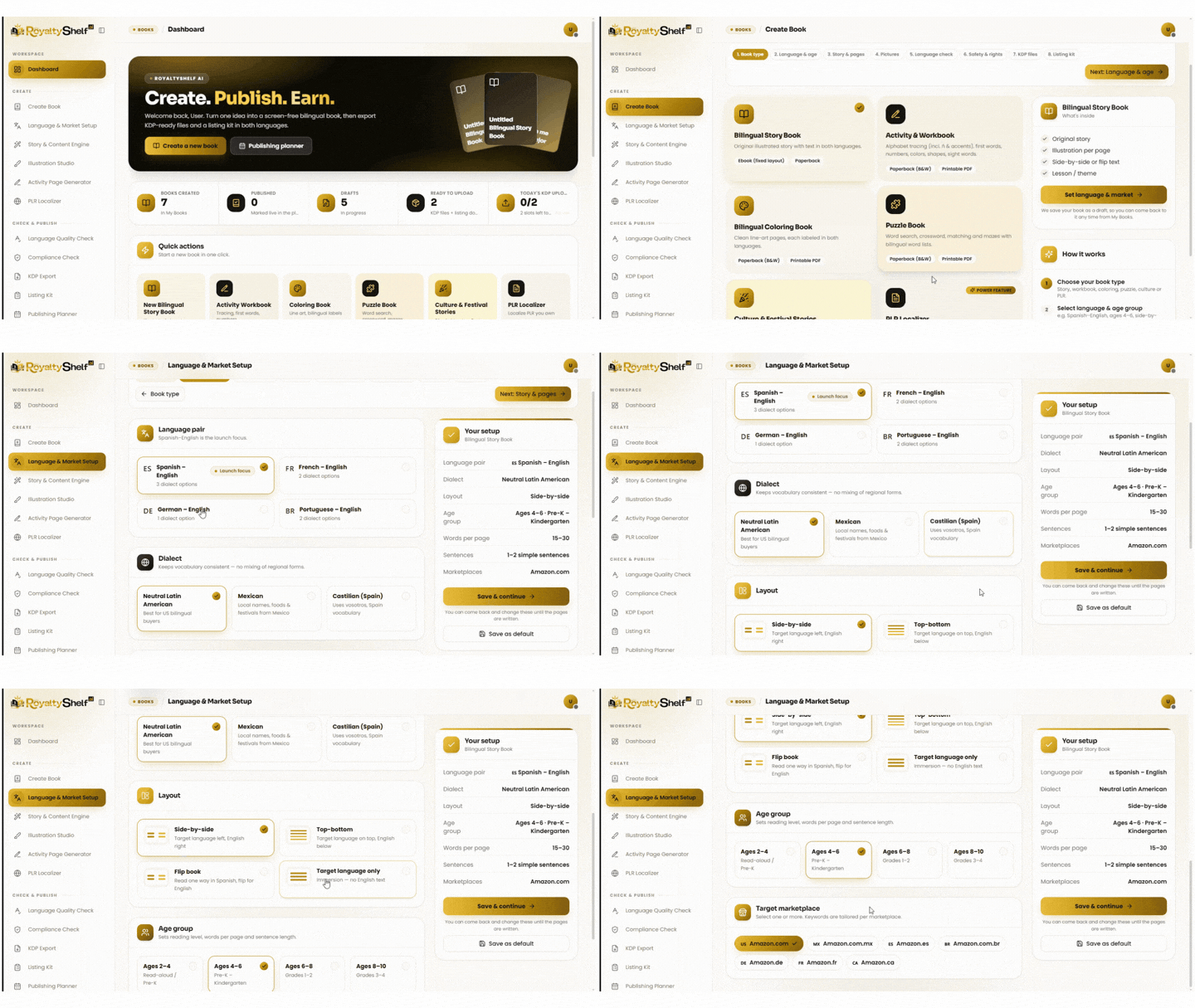
According to the product page, users can choose a book type, language, dialect, age group, and layout. The software then generates content, illustrations, and educational activities.
It also advertises a language quality checker with English back-translations.
Still, automated language checking can’t guarantee perfect grammar, cultural accuracy, or educational quality. A native-language reviewer can still be valuable.
Why Is Bilingual Book Publishing Interesting?
Bilingual educational publishing can reach an audience beyond readers of traditional English-only books.
Parents may want their children to learn two languages. Teachers may need classroom activities. Families may want stories that reflect their cultural backgrounds.
According to USAFacts, based on US Census Bureau data, approximately 44.9 million people aged five and older spoke Spanish at home in the United States in 2024. The number increased by 21.3% between 2010 and 2024.
This gives useful market context, but it doesn’t show how many people buy bilingual books or how much a new publisher can earn.
The opportunity lies in finding specific audiences and creating products that are genuinely useful to them.
Some potential audiences include:
- Spanish-speaking families.
- French-English learning households.
- Preschool teachers.
- Homeschooling parents.
- Bilingual education programs.
- Children learning a second language.
A bilingual book needs to meet a real educational need to be useful.
Does RoyaltyShelf AI Work?
The official sales page lays out a three-step process.
Step 1: Choose Your Book Type, Language and Age Group
First, select the kind of book you want to create.
Options advertised on the page include:
- Storybooks.
- Workbooks.
- Coloring books.
- Puzzle books.
- Cultural and festival stories.
- PLR localization.
Then choose a language pair, dialect, age group, and preferred layout.
For example, you could plan a Spanish-English coloring workbook for children aged four to six.
This helps define your audience before you generate the book.
Step 2: Let the AI Generate the Content
Once you’ve made your selections, the software generates the book content.
The advertised workflow includes:
- Writing bilingual stories.
- Creating illustrations.
- Generating tracing activities.
- Building word searches.
- Creating crosswords and matching activities.
- Generating mazes and answer keys.
- Checking language quality.
- One useful feature is the back-translation system.
For example, if you don’t understand Spanish, the English back-translation can help you see what the generated Spanish text is meant to say.
Still, check educational material for accuracy before publishing. Automated quality scores can’t replace professional proofreading.
Step 3: Export and Publish
The last step is to export your completed book.
The product page advertises several publishing assets:
- Paperback interior.
- Paperback cover with calculated spine width.
- Ebook file.
- Printable PDF.
- Bilingual listing kit.
You can then review the files and upload them to your Amazon KDP account.
Generating a book doesn’t guarantee it will succeed.
You still need to review the files, complete the publishing process, set a price, create an appropriate listing, and attract customers.
RoyaltyShelf AI Review: Features
The product page advertises a wide range of features. Here are the ones worth a closer look.
1. Six Bilingual Royalty Asset Types
RoyaltyShelf AI supports several educational publishing formats.
These include storybooks, activity workbooks, coloring books, puzzle books, cultural stories, and PLR localization.
This range gives publishers room to try different product categories.
2. Four Language Pairs
The advertised language options are:
- English and Spanish.
- English and French.
- English and German.
- English and Portuguese.
- The platform also offers dialect controls.
That matters because language differences can affect vocabulary, spelling, and cultural context.
3. Native-Language Story Engine
The software says it can create content in the selected language from the start, rather than translating a story written in English.
It also advertises age-appropriate vocabulary, localized names, and cultural themes.
This may suit publishers creating content for specific educational audiences.
However, someone familiar with the target language should still review the final writing.
4. Consistent Character Illustration Engine
Consistent illustrations matter in children’s storybooks.
When a character looks different from page to page, the finished book can feel unprofessional.
RoyaltyShelf AI advertises a character-generation system designed to keep appearances consistent throughout the book.
The advertised illustration styles include:
- Watercolor.
- Cartoon.
- Crayon.
- Line art.
Check the exported illustrations for inconsistencies, distorted details, and inappropriate elements.
5. Activity Page Generator
This feature is designed for educational workbooks.
It includes:
- Alphabet tracing.
- Word searches.
- Crosswords.
- Matching exercises.
- Mazes.
- Answer keys.
Before publishing, check that every puzzle has a correct solution.
6. PLR Localizer
The PLR Localizer is designed for people who already own private label rights content.
It advertises a license checker to confirm whether the supplied license allows translation and adaptation.
Owning a copy of a PLR product does not automatically give you permission to translate, modify, or resell it in every format.
Read the original license carefully before using third-party content.
7. Language Quality Check
This feature reportedly checks:
- Grammar.
- Spelling.
- Dialect consistency.
- Reading level.
- Meaning.
It also provides an English back-translation.
For publishers who don’t speak the target language, this can help with review. I would still recommend having a native speaker review children’s educational content.
8. Uniqueness and Compliance Check
The software advertises a uniqueness score, child-safety checks, and restrictions related to known characters, brands, and real people.
It also includes an AI disclosure helper.
These features can help organize the publishing process, but a software-generated compliance result can’t guarantee Amazon approval or remove copyright risks.
9. One-Click KDP Export
Formatting is one of the most time-consuming parts of self-publishing.
RoyaltyShelf AI advertises exports that include:
- Paperback interiors.
- Covers with spine calculations.
- Ebook files.
- Printable PDFs.
Before submitting anything to KDP, check the final trim size, margins, bleed, page count, and how the file renders.
10. Bilingual Listing Kit
The listing generator reportedly prepares:
- Book titles.
- Subtitles.
- Product descriptions.
- Keywords.
- Categories.
- Age and grade ranges.
- Author biographies.
- A+ content text.
These materials can give you a starting point, but review the listing yourself.
Your keywords should reflect actual search intent, and your description should accurately describe the finished book.
11. Publishing Planner
A publishing planner helps you track titles and organize your upload schedule.
This can be useful if you plan to publish multiple products over time.
Still, publishing volume should never take priority over book quality.
12. Rights and Records Vault
The product advertises a system for storing licenses, original files, and generation records.
Keeping these records can help you organize your publishing business and document where your content came from.
You are still responsible for making sure you have the necessary rights.
What Types of Books Can You Create?
Here are six practical categories to consider.
| Book type | Example product |
| Storybooks | Spanish-English bedtime stories |
| Workbooks | Bilingual alphabet exercises |
| Coloring books | Animals with bilingual names |
| Puzzle books | Vocabulary word searches |
| Cultural stories | Holiday and festival books |
| PLR adaptations | Properly licensed bilingual educational materials |
For beginners, I would recommend starting with one specific audience and one useful product.
For example, instead of creating a general bilingual workbook, create a Spanish-English alphabet workbook for preschool children.
A clearly defined audience makes it easier to research competitors, identify keywords, and write a relevant product description.
Can You Earn Money With RoyaltyShelf AI?
This is probably the most important question.
The short answer is yes: selling books through Amazon KDP can earn royalties. But buying RoyaltyShelf AI doesn’t guarantee that your books will sell.

You need to understand how the business works.
Understanding Amazon KDP Royalties
Amazon KDP uses different royalty rates based on the book format, marketplace, and pricing conditions.
For paperback books sold through eligible Amazon marketplaces, the royalty calculation is:
Royalty = (List Price x Royalty Rate) – Printing Cost
For example, Amazon’s official documentation shows a $15 paperback with a 60% royalty rate and a $5 printing cost.
(15 x 0.60) – 5 = $4
In this example, that works out to a $4 royalty per qualifying sale.
Amazon Kindle Direct Publishing
This is a calculation example, not a forecast of what your book will earn.
What About the $900 Monthly Royalty Example?
The RoyaltyShelf AI sales page provides an illustrative calculation:
| Books | Daily sales per book | Assumed royalty | Monthly royalties |
| 10 | 1 | $3 | $900 |
| 25 | 1 | $3 | $2,250 |
| 50 | 1 | $3 | $4,500 |
| 100 | 1 | $3 | $9,000 |
The arithmetic assumes every book sells one copy a day for 30 days, but that doesn’t mean every published book will sell every day.
That assumption matters.
Some may make no sales, while others may perform better. Treat these figures as hypothetical scenarios, not realistic income expectations.
Other Costs to Consider:
Even if the software creates your files, running a publishing business may involve:
- Software upgrades.
- Native-language proofreading.
- Advertising.
- Research tools.
- Cover improvements.
- Marketing and promotion.
- Taxes and payment-related costs.
Paperback printing costs are also deducted from royalties. Amazon calculates them based on factors such as page count, ink type, and marketplace.
7 Ways to Use RoyaltyShelf AI for Business
The official product page describes seven potential income models.
1. Paperback Publishing
Create bilingual storybooks, workbooks, coloring books, and puzzles.
Upload them to KDP and earn royalties when qualifying copies sell.
2. Kindle Ebook Publishing
Convert suitable stories into ebook formats.
This gives readers another way to access your content. Make sure the content and layout suit the ebook format.
3. International Publishing
The product advertises publishing opportunities across several Amazon marketplaces.
Research local demand and check distribution availability before creating a product for a specific country.
4. Printable PDF Products
You may be able to sell printable educational resources through platforms such as Gumroad or Payhip.
Check the platform’s current terms and make sure your commercial license covers the intended use.
5. Seasonal Products
Create educational products for specific events and occasions.
Examples include:
- Christmas activity books.
- Back-to-school workbooks.
- Cultural festival coloring books.
- Holiday vocabulary activities.
Plan seasonal products ahead of the relevant buying period.
6. PLR Localization
If you already own properly licensed PLR content, you may be able to adapt it for another language or audience.
Verify translation and derivative-work rights first.
7. Custom Bilingual Book Services
You could offer custom educational book creation to:
- Teachers.
- Tutors.
- Daycare centers.
- Homeschooling families.
- Small educational organizations.
For example, a teacher might want a custom bilingual workbook for a particular classroom.
This business model requires customer research, clear service agreements, and careful quality control.
Pricing: How Much Does It Cost?
| Stage | Offer | Price |
|---|---|---|
| FE | Royalty Shelf AI | $14 |
| FE | Royalty Shelf AI Special | $24 |
| OTO1 | Royalty Shelf AI Unlimited | $47 |
| RoyaltyShelf AI Unlimited Elite | $97 | |
| RoyaltyShelf AI Unlimited DS | $37 | |
| OTO2 | Royalty Shelf AI Global-Expansion | $67 |
| RoyaltyShelf AI Global Expansion DS | $62 | |
| OTO3 | Royalty Shelf AI Autopilot | $67 |
| RoyaltyShelf AI Autopilot DS | $57 | |
| OTO4 | Royalty Shelf AI DFY | $97 |
| RoyaltyShelf AI DFY DS | $67 | |
| OTO5 | Royalty Shelf AI Booster | $67 |
| RoyaltyShelf AI Booster DS | $62 | |
| OTO6 | Royalty Shelf AI Agency | $97 |
| RoyaltyShelf AI Agency DS | $87 | |
| OTO7 | Royalty Shelf AI Reseller | $147 |
| RoyaltyShelf AI Reseller DS | $127 | |
| OTO8 | Royalty Shelf AI Whitelabel | $297 |
| RoyaltyShelf AI Whitelabel DS | $247 |
RoyaltyShelf AI vs. Ordinary AI Writing Tools
| Feature | RoyaltyShelf AI | General AI writing tools |
| Bilingual book workflow | Advertised | Usually requires manual setup |
| Story generation | Included | Often available |
| Illustrations | Included in advertised workflow | Depends on tool |
| Activity generation | Dedicated feature | May require prompts or other tools |
| Language checking | Built-in advertised system | Depends on tool |
| KDP formatting | Dedicated export | Often requires extra work |
| Listing generation | Advertised | Usually prompt-based |
| Rights management | Dedicated records feature | Usually manual |
RoyaltyShelf AI’s main selling point is its specialized publishing workflow.
However, a general AI writing tool combined with illustration and formatting software could also be used to create bilingual books.
Therefore, the best option depends on whether you value convenience, customization, flexibility, or cost.
Important Amazon KDP Rules You Must Understand
Before you publish any AI-generated book, make sure you understand Amazon’s requirements.
AI-generated Content Disclosure
Amazon distinguishes between AI-generated and AI-assisted content.
You must disclose AI-generated text, images, and translations when publishing through KDP.
AI-assisted content, such as editing or brainstorming your own work, is treated differently.
Amazon also holds publishers responsible for checking intellectual-property rights and ensuring their content complies with its rules.
Copyright and Intellectual Property
Avoid using:
- Copyrighted characters.
- Existing book illustrations.
- Trademarked brands without permission.
- Unauthorized translations.
- Third-party content without suitable rights.
A uniqueness score doesn’t establish legal originality.
Book Quality
Your book should offer readers a good experience.
Check:
- Spelling and grammar.
- Translation accuracy.
- Age appropriateness.
- Illustration quality.
- Correct puzzle answers.
- Consistent formatting.
- Accurate product descriptions.
Poor reviews can damage your publishing business.
How to Start a Bilingual KDP Publishing Business

Here’s a practical strategy for beginners.
Step 1: Research a specific audience.
Choose a clearly defined group, such as Spanish-English preschool learners.
Step 2: Research competing books.
Search Amazon for similar books. Examine their covers, page counts, reviews, prices, and educational content.
Step 3: Find a specific problem to solve.
Instead of publishing another generic coloring book, create a resource that teaches something useful.
Step 4: Create one sample book.
Use RoyaltyShelf AI or another suitable tool to prepare the initial content.
Step 5: Review everything.
Get native-language feedback and check educational accuracy.
Step 6: Prepare the Amazon listing.
Use relevant keywords, a clear title, an informative description, and an attractive cover.
Step 7: Calculate your expected royalty.
Use the official Amazon KDP Royalty Calculator to estimate printing costs and royalties.
Step 8: Publish and monitor performance.
Track impressions, clicks, conversions, reviews, and actual royalties.
Step 9: Improve before scaling.
Use customer feedback to guide changes instead of focusing on publishing more books.
Pros and Cons: RoyaltyShelf AI Review
Pros
- Brings several publishing tasks together on one platform.
- Supports four advertised language pairs.
- Generates stories and activity books.
- Can generate illustrations.
- Provides an English back-translation.
- Offers KDP-ready exports.
- Includes a listing generator.
- Has a feature for managing rights and records.
- Advertises a one-time launch offer.
Cons
- Sales and royalties aren’t guaranteed.
- Generated translations need independent review.
- The front-end may limit how much you can generate.
- Extra upgrades may raise the total cost.
- Publishing on KDP still involves manual work.
- Competition in the market remains a major challenge.
- A software compliance score can’t guarantee account approval.
- Generated book quality needs to be tested in practice.
Who Should Buy RoyaltyShelf AI?
RoyaltyShelf AI may suit you if you:
- Want to explore publishing books in two languages.
- Are interested in educational products for children.
- Already work with Amazon KDP.
- Want to make book creation and formatting easier.
- Have ideas for educational resources in multiple languages.
- Are comfortable reviewing and improving AI-generated content.
Who Should Avoid It?
You should probably avoid it if:
- You expect passive income to be guaranteed.
- You’d rather not research the publishing market.
- You aren’t willing to review generated translations.
- You expect the software to publish and market books for you.
- You want to earn money right away without first building quality products.
The software may simplify production, but it can’t replace market research, editorial judgment, or marketing.
RoyaltyShelf AI Review: Frequently Asked Questions
1. What is RoyaltyShelf AI?
RoyaltyShelf AI is an AI-powered book creation platform designed to generate bilingual educational books and prepare files for publishing on Amazon KDP.
2. Do I need to speak Spanish to use RoyaltyShelf AI?
The software advertises bilingual content generation and back-translation into English. A native speaker should still review the final content.
3. Can RoyaltyShelf AI create children’s coloring books?
Yes. Coloring books are among the publishing asset types it advertises.
4. Can I publish RoyaltyShelf AI books on Amazon KDP?
The software advertises KDP-ready exports, but you still need to review the files, upload them, and follow Amazon’s publishing guidelines.
5. Does Amazon allow AI-generated books?
Amazon allows AI-generated content under its policies. Publishers must disclose AI-generated text, images, and translations, and remain responsible for compliance.
6. Does RoyaltyShelf AI guarantee income?
No. Neither the software nor Amazon guarantees sales or royalties.
7. What languages does RoyaltyShelf AI support?
The sales page advertises Spanish, French, German, and Portuguese, each paired with English.
8. Can I sell printable PDFs?
The product advertises printable PDF exports and suggests selling them through external platforms. Check your license and the relevant platform’s terms.
9. Is there a money-back guarantee?
The official page advertises a 30-day money-back guarantee. Check the current refund terms before purchasing.
10. Is RoyaltyShelf AI suitable for beginners?
Its advertised workflow is beginner-friendly. Beginners should still learn the basics of publishing, copyright, market research, and book quality requirements.
11. Does Amazon handle printing and shipping?
For eligible print-on-demand books, Amazon prints and ships orders. It deducts printing costs when calculating royalties.
12. Is the $14 offer permanent?
The $14 amount is an advertised launch offer and may change. Don’t assume the price is permanent.
Final Verdict: Is RoyaltyShelf AI Worth It?
RoyaltyShelf AI offers a practical set of tools for AI-assisted publishing.
Its main advantage is the mix of bilingual writing, illustration generation, educational activities, language checking, and KDP-oriented exports.

Rather than switching between several applications, users may be able to handle much of the book production process in one place.
There are limits to keep in mind, though.
Creating a book doesn’t automatically build a successful publishing business. You still need to research your audience, create valuable educational content, check translations, follow Amazon’s policies, and promote your books.
Pay close attention to the language quality checker, native-language review process, and publishing exports. These features can make a real difference to the finished product.
RoyaltyShelf AI is worth investigating if you genuinely want to pursue bilingual educational publishing. The advertised $14 launch price makes it relatively inexpensive to try, but check the included limits, upgrades, and refund terms before buying.
Don’t buy it based on hypothetical monthly royalty calculations. Buy it only if its features solve a real problem in your publishing workflow.
Bonus From Me
If you buy RoyaltyShelf AI through my affiliate link, I’ll send you an exclusive bonus package at no extra cost. The bonuses can help you get better results and more value from your purchase. Check All Bonuses
How to Claim Your Bonuses
Follow these steps:
Step 1: Clear your browser cookies or open a new private/incognito window so the tracking works correctly.
Step 2: Click the button below to buy RoyaltyShelf AI through my recommended link.
Use Coupon EARLYSHELF – $10 Off – Early window
Step 3: After your purchase, email your payment receipt or confirmation email to marketerssaifbd@gmail.com. Once I verify your purchase, I’ll send all your exclusive bonuses directly to your email.
Thanks for reading this review. I hope this RoyaltyShelf AI Review helps you decide whether to buy.
🔥 Read Also: DOMAIN Deck Review 2026: Is This AI Domain Business Worth It?
